
When a major hurricane, ice storm, or flooding event strikes, electricity grids collapse instantly. Emergency responders, hospital backup generators, and clearing crews require millions of gallons of diesel and gasoline to keep vital operations running. Delivering fuel during these critical moments represents the ultimate challenge in supply chain management. Fleet operators and emergency response directors rely on emergency fuel delivery to survive the post-disaster environment. Moving fuel into Federal Emergency Management Agency (FEMA) declared disaster zones requires rigorous coordination, specialized equipment, and real-time adaptability.
Mastering Emergency Fuel Delivery in Active Disaster Areas
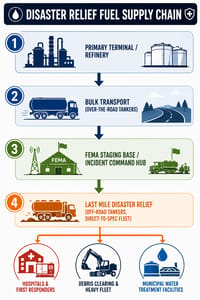
The “last mile” refers to the final, most complex leg of the supply chain. In normal business operations, last-mile logistics focus on speed and customer convenience. In disaster relief operations, last-mile logistics determine survival.
Flooded highways, downed power lines, and debris-strewn streets block access to critical destinations. Traditional gas stations shut down without utility power. Furthermore, localized fuel shortages create massive regional panics. Dedicated fuel dispatchers solve these obstacles through dedicated emergency fuel delivery systems. Experienced drivers navigate hazardous terrain using all-wheel-drive tank trucks and specialized off-road discharge equipment.
Regulatory Hurdles and FEMA Compliance
Fuel providers cannot simply drive a tank truck into a federal response zone. FEMA establishes strict operational frameworks to manage resource allocation and site security.
Essential FEMA Authorization Steps
-
Federal Contracting Setup: Providers complete registration as approved Transportation Service Providers (TSPs).
-
Access Security Credentials: Fleet drivers secure specialized disaster access passes to enter restricted zones.
-
Hazardous Materials Compliance: Operations maintain strict DOT and EPA compliance despite emergency rule waivers.
-
Integration with Command Structures: Dispatchers sync movements directly with Incident Command System (ICS) logistics cadres.
Consequently, effective emergency fuel delivery demands extensive pre-event planning. Fuel partners must hold active federal contracts and regional permits long before a storm makes landfall.
Overcoming Infrastructure Failure with Dedicated Supply Chains
Disaster zones rarely feature working fuel pumps, digital payment systems, or reliable mobile internet. Therefore, reliable emergency fuel delivery relies on self-sustained support assets.
Relief fleets transport their own satellite communications gear, auxiliary power generators, and mobile fuel monitoring tech. Additionally, dispatchers deploy mobile fuel storage bladders and temporary skid tanks directly to staging areas. These temporary assets turn empty parking lots into functioning fuel hubs within hours.
As a result, municipal teams, telecommunications firms, and health systems maintain continuous power. Reliable emergency fuel delivery keeps emergency operations active through prolonged outages.
Prioritizing Critical Infrastructure
During catastrophic outages, demand for fuel far exceeds immediate local supply. Logistics coordinators prioritize fuel routing based on life-safety criteria:
-
Healthcare Systems: Hospitals and urgent care centers receive top-tier delivery status for backup power.
-
Emergency Services: Police, fire, and search-and-rescue fleets access continuous mobile refueling.
-
Utilities: Water treatment plants and power grid repair fleets secure steady diesel supplies.
-
Communications: Cell tower generators get direct emergency fuel delivery to preserve emergency networks.
Because emergency situations change rapidly, dispatchers constantly adjust routing priorities. Modern telemetry systems track generator fuel levels in real time, triggering automatic dispatch before tanks run empty.
Strategic Pre-Positioning: The Key to Last-Mile Success
Successful disaster logistics depend heavily on proactive planning. Fuel management teams track severe weather patterns days before disaster strikes. Logistics managers pre-position fuel assets just outside the projected impact zone.
Subsequently, when FEMA issues official disaster declarations, pre-staged tank fleets immediately advance into the area. Rapid deployment minimizes response lag and saves critical hours. Ultimately, choosing a seasoned fuel partner guarantees uninterrupted access to emergency fuel delivery when disaster strikes your region.